You're over 50.
The math is
different.
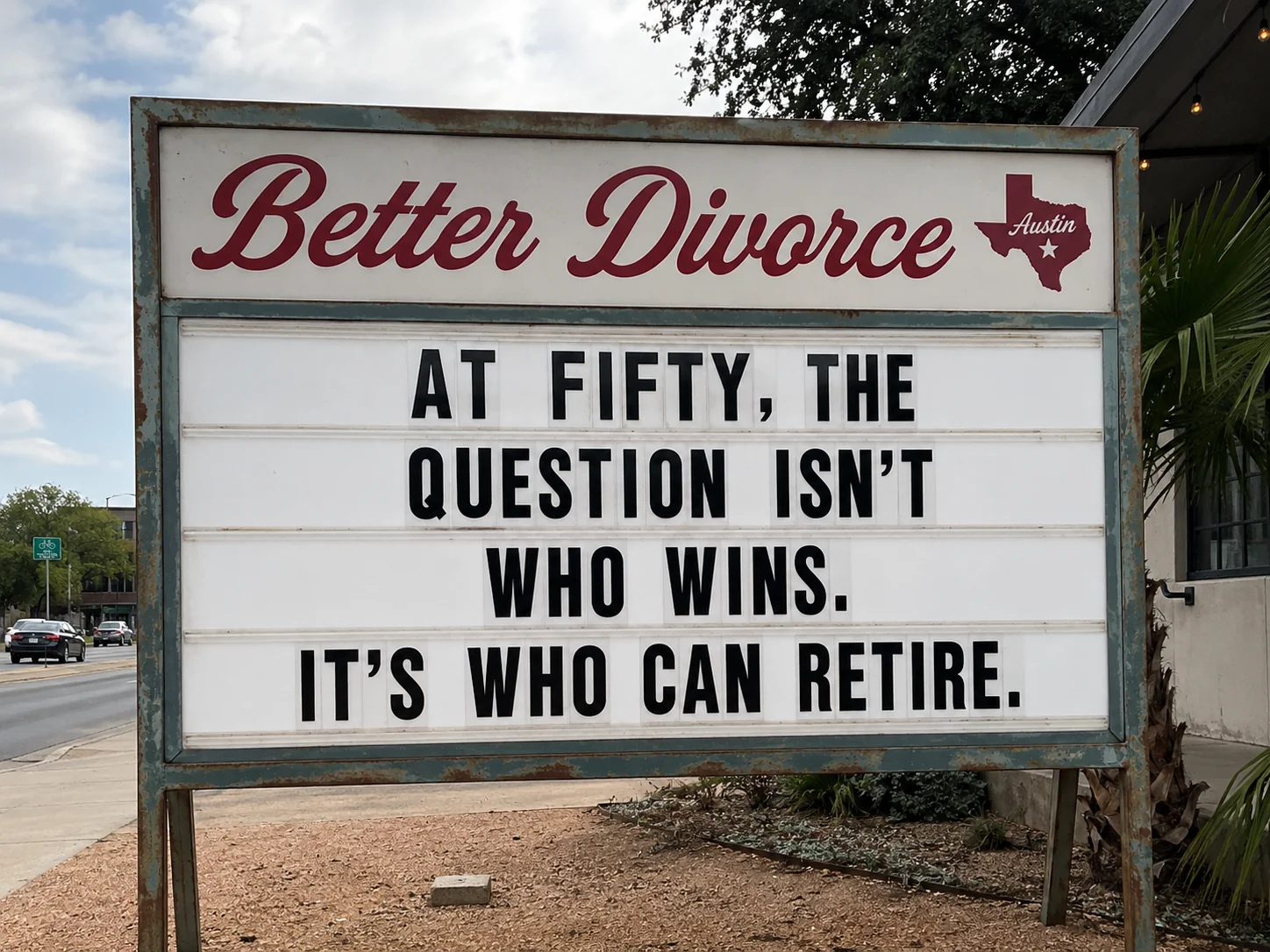
"Divorce at fifty is not the same arithmetic as divorce at thirty-five.
The years to recover are shorter. The choices have to be better."
Why divorce at fifty
is its own thing.
Divorcing in your fifties or sixties is structurally different from divorcing in your thirties because the time to recover is shorter and the choices are heavier. A long marriage usually means real retirement balances, possible spousal maintenance under Texas Family Code § 8.051, the ten-year Social Security question, and a healthcare gap to bridge before Medicare at 65. The arithmetic that worked at thirty-five no longer works. The plan has to be better.
The work on these cases is not louder. It is more careful. We are not fighting over who keeps the toaster. We are designing a settlement that funds two retirements out of one estate that was built to fund one. That is a real engineering problem, and it deserves real attention from someone who has done it before.
We coordinate with your financial advisor and CPA from day one. The legal answer and the financial answer have to match.
Spousal maintenance:
when Texas actually
allows it.
Texas is one of the least generous spousal maintenance states in the country, and that surprises people. Under Texas Family Code § 8.051, a court may award maintenance only if the spouse seeking it lacks sufficient property to provide for minimum reasonable needs and one statutory ground applies. The most common ground in long marriages is a marriage of ten years or more combined with the inability, after diligent effort, to earn enough to meet minimum reasonable needs.
Two more limits are written into the statute, and they matter. Section 8.054 caps duration: 5 years for marriages of 10–19 years, 7 years for 20–29 years, and 10 years for 30 years or more. Section 8.055 caps the monthly amount at the lesser of $5,000 or 20% of the obligor’s average gross monthly income. Most settlements we negotiate over fifty include some form of contractual support that goes beyond these statutory limits, because the statute is a floor, not a ceiling, when both spouses agree.
Retirement accounts and
the QDRO process.
Retirement is usually the largest asset in an over-50 divorce, and Texas Family Code § 7.003 requires the court to divide it as part of the just-and-right division under § 7.001. The community portion is what was contributed during the marriage, plus the growth attributable to that contribution. The pre-marriage balance is separate property, traceable with statements.
How the asset gets divided depends on what kind of account it is. A 401(k), 403(b), or pension governed by ERISA cannot be split by the divorce decree alone. It requires a Qualified Domestic Relations Order, or QDRO, a separate court order drafted to the plan administrator’s specifications and approved by the plan. IRAs are different: they divide through the divorce decree itself under a “transfer incident to divorce,” with no QDRO required. Government and military retirement use their own analogous orders.
Done correctly, none of these transfers triggers tax. Done incorrectly, the entire transfer can be treated as a taxable distribution. We use specialist QDRO drafters and review every order before submission.
Social Security and the
do-no-harm rule.
Social Security is federal and outside the reach of Texas community property law, but it shapes the divorce in ways most people don’t realize. If your marriage lasted ten years or longer, federal rules let you claim a spousal benefit on your ex-spouse’s earnings record at full retirement age, provided you are unmarried at the time you claim. Your benefit does not reduce theirs, and they are never notified. If you remarry before age 60, you lose access to that ex-spouse benefit unless that later marriage also ends.
The do-no-harm rule we apply: if a couple has been married 9 years and 7 months, we do not file a divorce that closes before the tenth anniversary unless there is a compelling reason. Five months of waiting is cheap insurance against a lifetime of foregone benefits. We also coordinate claiming-strategy timing with a financial planner because for many spouses over sixty, the difference between claiming at 62, full retirement age, and 70 is the difference between modest and comfortable.
Healthcare insurance:
the gap before 65.
The years between the divorce and Medicare eligibility at age 65 are the most expensive insurance years of an adult life, and they are usually the years that derail an otherwise reasonable settlement. If you were covered under your spouse’s employer plan, that coverage ends at divorce. Three paths typically remain.
COBRA continuation lets a divorced spouse stay on the employer plan for up to 36 months, but the divorced spouse pays the full unsubsidized premium plus a 2% administrative fee, which often runs $700–$1,500 a month for a single adult. The ACA marketplace is the second path, with subsidies that depend on post-divorce income. Those calculations matter: spousal maintenance counts toward income; a one-time property settlement does not. The third path is your own employer plan, which is the cleanest if available.
We model the bridge years explicitly in the settlement, treat the premium gap as a real number, and build it into the property division.
Estate planning
consequences.
A divorce decree resolves the marriage. It does not, by itself, rewrite your estate plan, and the gap between those two facts has caused more accidental inheritances than any other failure in this practice. The day the decree is signed, several documents need to be revisited.
Wills usually treat a former spouse as predeceased under Texas law once the divorce is final, but the will should be redrafted anyway because most of the named guardians, executors, and contingent beneficiaries are tied to a structure that no longer applies. Beneficiary designations on retirement accounts, life insurance, and transfer-on-death accounts are governed by federal law (for ERISA plans) and contract law, not the decree. They must be changed manually with each custodian. Powers of attorney and medical directives naming a spouse should be revoked and replaced. Revocable trusts often need amendment or restatement.
We do not draft estate documents, but we coordinate closely with your estate attorney and give you a checklist on the day the decree signs. Many of these tasks take an afternoon. None of them take care of themselves.
The adult children,
and what we will need
from you.
Adult children are not parties to the divorce. They have no legal standing, no required notification, and no role in the negotiation. They will, however, have feelings and opinions, and in long-marriage divorces those opinions tend to arrive loudly and on holidays. The legal work is ours. The family management is yours.
What we will ask of you: keep case-related conversations out of group texts and family dinners. Do not show your children the draft inventory. Do not ask them to choose sides on questions of property or maintenance. Do not forward your spouse’s emails to them. We have seen otherwise dignified settlements unravel because an adult child read a discovery response over Thanksgiving and weighed in.
What we will offer: a written communication plan if your children are pressing for information, talking points that respect their relationship with both parents, and a recommendation for a family therapist who works with adult children of divorce. The legal case stays in the legal channel.
Honest answers
to fair questions.
"I'm 58 and my spouse earned most of the money. Will I get spousal maintenance?"
Maybe. Texas Family Code § 8.051 requires a marriage of ten years or more and that you cannot meet your minimum reasonable needs. Even when both apply, § 8.054 caps duration at 5, 7, or 10 years depending on length of marriage, and § 8.055 caps the amount at the lesser of $5,000 a month or 20% of average gross monthly income. Texas is not a generous maintenance state.
"Do I lose half my 401(k)?"
You divide the community portion. What was contributed during the marriage is community property under Texas Family Code § 7.003 and gets divided "just and right" (§ 7.001). What was in the account before the marriage is separate, with the growth on that base traceable. Most divisions are not exactly fifty-fifty.
"Will I lose my Social Security?"
No. Federal rules let you claim on an ex-spouse's record if the marriage lasted 10+ years and you are unmarried at the time you claim. We coordinate the divorce timeline carefully when a couple is close to that ten-year mark.
"How will I have health insurance until Medicare?"
Three options usually: COBRA from the employee spouse's employer (up to 36 months for a divorced spouse, expensive), the ACA marketplace, or coverage through your own employment. We plan for the gap years before age 65.
"Do my adult children have any say in this?"
Legally, no. Practically, they will have feelings, sides, and opinions. Our job is the legal work; what we ask of you is to keep the case-related conversations off the family group text.
"What does this cost?"
For most over-50 matters with retirement assets and a long marriage, $20k–$60k all-in. QDROs add modest preparation cost. We give you a real estimate after the first conversation, not after a retainer.
Schedule the
first conversation.
An hour with Cristi — $250, first hour prepaid, on the phone or at our offices on Bee Caves. Not a sales pitch — real legal advice from a board-certified attorney. We'll tell you what we'd do, what it'd cost, and whether you even need a firm like ours.