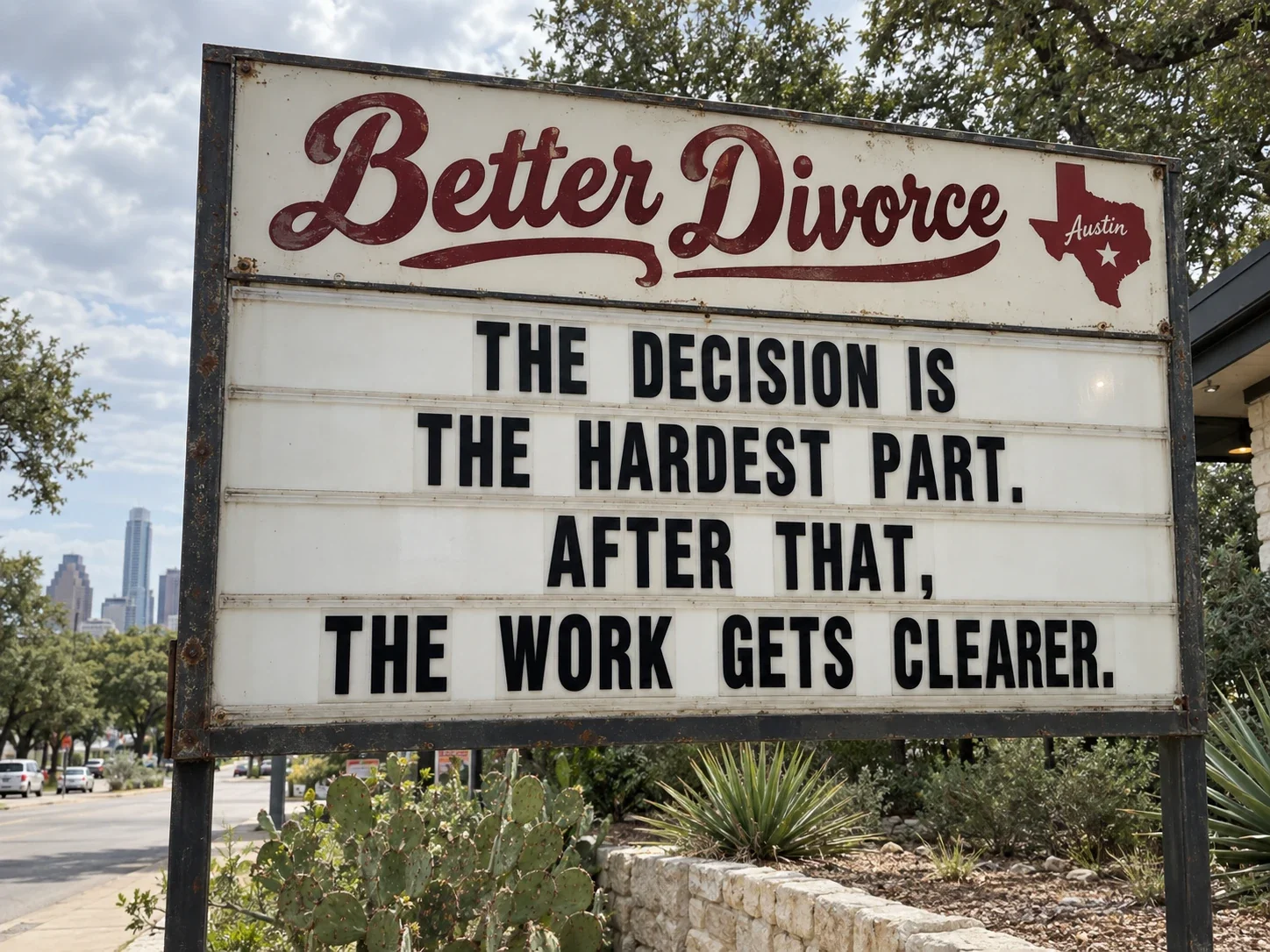
The hardest part is
deciding whether
to decide.
"Half the people I talk to don't end up filing.
Either way, the conversation is worth having."
The decision before
the decision.
If you are reading this, you have probably been deciding whether to decide for months. That is the right place to be, and it is the hardest part. The decision to make the decision is, in our experience, what takes years. The divorce itself, once decided, takes months.
We do not believe in pushing people toward divorces they do not want. Roughly half of the first conversations we have do not turn into matters. Some become reconciliations. Some become a year of waiting. Some become a different professional, not a lawyer: a therapist, a financial planner, a quiet priest. That is all fine.
What this page describes is the first conversation. Not the divorce. Just the call.
What “the first
conversation” actually is.
It is an hour with Cristi, on the phone or in our offices on Bee Caves — $250, with the first hour prepaid. It is real legal advice from a board-certified attorney, not a sales call. No engagement letter, no homework before, and no follow-up email pressuring you to “next step.” You leave with a clear read on your options, a realistic cost-and-timeline estimate, and a straight recommendation.
What we will ask:
- How are you? The honest answer matters. We are listening for what you are afraid of, not what you have decided.
- What is the shape of your situation? Married how long, kids how old, what each of you does for a living, what assets are in play. The contours, not the line items.
- What are you trying to protect? The kids. The company. The relationship with your in-laws. The summer house. Sometimes the marriage itself. We are not here to tell you which.
- What is the question you are afraid to ask? Almost everyone has one. We make it safe to ask.
You will leave the call with: a sense of what the next thirty days could look like, a real cost estimate if you decide to proceed, and either a recommendation to file, a recommendation to wait, or a recommendation to see someone other than a lawyer.
The Texas baseline.
A few facts about Texas divorce that change the shape of the conversation, even at this stage:
- Texas is a no-fault state. You can end a marriage without proving anyone did anything wrong. The legal phrase is “insupportability” (Texas Family Code § 6.001). We wrote a separate piece on what that does and does not mean: What “no-fault” actually means in Texas.
- Sixty-day minimum. No Texas divorce can close in less than 60 days from filing (§ 6.702). That window is not a delay. It is a built-in pause, and we use it.
- Community property. What was earned or acquired during the marriage is community (§ 3.002), and the court divides it “just and right” (§ 7.001), not automatically half.
- Standing orders apply on day one. The moment you file in Travis County, automatic restrictions kick in around assets, accounts, and the kids. Here is how standing orders, TROs, and protective orders differ.
If you are still considering, none of these have happened yet. They are the structure your decision sits inside.
What not to do yet.
Before you decide, do not do any of the following. They are easy to undo while you are still considering, and very hard to undo after.
- Don’t move money. Not to your sister’s account “for safekeeping.” Not into a new account in your name only. The community-property presumption (§ 3.003) sweeps that back in. Worse, it makes you look like you are hiding assets when you are not.
- Don’t tell the kids. Not yet. You do not have answers yet, and they will ask.
- Don’t post anything. No vague Instagram captions. No therapist-quoted Facebook posts. Texas family courts read social media. Opposing counsel reads social media. What feels like venting reads like evidence.
- Don’t move out without thinking it through. Whoever moves out first usually keeps living elsewhere. Sometimes that is the right move. It is rarely the right move on impulse.
- Don’t lawyer up before you call us. An aggressive retainer with the wrong firm can lock the case into a posture that does not match what you actually want.
You do not need to do anything yet. That is the whole point of “considering.”
What to start gathering,
quietly.
If you do decide to proceed, the work goes faster if a few things are already on hand. None of this requires action. None of it tips your hand. Most of it lives in your inbox already.
- Three years of tax returns. Yours and joint.
- Recent statements for every account either of you has: checking, savings, investment, retirement, credit cards.
- Pay stubs from the last 90 days, both of you if available.
- A short list of recurring expenses: mortgage, utilities, insurance, daycare. The things the household actually depends on.
- A list of “the big assets”: house, vehicles, business interests, anything large enough you would notice if it disappeared.
Make the list on your own device, not a shared one. Save it somewhere your spouse cannot accidentally see. None of this is hostile. All of it is preparation.
What we listen for
in a first call.
We are not listening for whether you are “ready.” Most of our clients are not ready in the way the word implies. We are listening for three things.
- Direction. Some people walk into the call already decided. Others walk in because the deciding has gotten too heavy to carry alone. Both are fine. They are different conversations.
- Risk. If anyone in the household is unsafe (physically, financially, with a child), that changes the order of operations and the urgency of the next thirty days. We will tell you.
- Misalignment. If what you are describing does not match what we hear in your tone, we say so. Sometimes the question someone is asking is not the question they want answered.
After an hour, we usually have a good read on which of three buckets you are in: ready to file, not ready, or it-is-not-our-firm-you-need.
What happens after
we hang up.
Three things, in three different timeframes.
Within the same day: we send a short summary email: what we discussed, what we suggested, no fluff. If you asked for a fee estimate, it is in that email. If we recommended a different professional, their name is in that email.
Within a week: nothing, unless you reach out. We do not chase. We do not put you in a CRM. We do not market to you.
If and when you decide to proceed: we set up an engagement, send the retainer, and start work the same week. The case unfolds at a pace you set. We give you weeks of warning before any decision touches the rest of your life. Never days.
Honest answers
to fair questions.
"I'm not sure I even want a divorce. Is it too early to call?"
No. About half of our first conversations do not become matters. The initial consult is a paid hour with Cristi — $250, prepaid — and it is real legal advice, not a sales pitch. We are not in the business of pushing people who should not be pushed.
"What should I bring or prepare?"
Nothing. Do not gather paperwork yet. Do not make spreadsheets. The first call is about you, not about your assets. Those come later, if they come at all.
"Will my spouse find out I called?"
Not from us. There is no engagement until you ask for one. The conversation is private, and the call is not logged anywhere your spouse could ever see.
"What if I haven't told anyone yet?"
Then we will be the first. Most of our first conversations happen before family, friends, or therapists know. There is no pressure to tell anyone after, either.
"How long does a Texas divorce take if I do file?"
Sixty days minimum from filing (Texas Family Code § 6.702), and most uncontested matters close at day 61. Contested cases usually run 5–18 months, sometimes longer.
"What does it cost, including doing nothing?"
Doing nothing costs nothing. Filing varies by complexity. We give you a real estimate at the end of the first conversation, not after a retainer.
Pick up
the phone.
An hour with Cristi — $250, first hour prepaid, on the phone or at our offices on Bee Caves. Not a sales pitch — real legal advice from a board-certified attorney. We'll tell you what we'd do, what it'd cost, and whether you even need a firm like ours.